Content text for a top bar



Content text for a top bar
.jpeg)
Share with your community!

Last Prime Day, ad spend surged 283% compared to the two weeks before the event, but revenue grew only 183% over the same period. Brands spent more and got less in return.
But not every brand ended the event in the same position. There was a divide between the brands still using the old playbook and those that became early adopters of agentic retail.
The brands that used AI agents to optimize for real-time incrementality saw the opposite result: they grew sales without growing spend at the same rate. One packaged foods brand grew ad sales nearly 4x with only 7% more spend, and a drinkware brand scaled spend 5.5x while keeping iROAS above 4.
During Prime Day 2026, the brands that got ahead last year will likely dominate again — especially as the stakes rise with Amazon's Alexa for Shopping driving more sales. According to Amazon, the AI shopping agent reached 300 million customers last year and drove nearly $12 billion in incremental sales. Of the shoppers who prompt the shopping agent, nearly 20% continue the conversation about a recommended brand.
For brands that haven't yet brought agentic retail into their operations, it isn't too late to get on board in the months leading up to Prime Day. But time will run out, as agentic retail isn’t something to simply switch on. AI agents need time to learn a brand's rules, category trends, content gaps, and goals before they can begin to monitor, recommend, and execute at the level Prime Day demands.

Using agents in retail isn't like purchasing new software, plugging it in, and expecting immediate results. Like human team members, agents need training and time to learn the contextual foundation before they can act. The lift is heavier, but the payoff is bigger — brands aren't just getting data, they're getting outcomes that grow the business.
Anyone who's used ChatGPT or any LLM knows the output is only as strong as the context it's given. Agents are no different — the more time that's spent providing brand-specific feedback, the sharper their recommendations get.
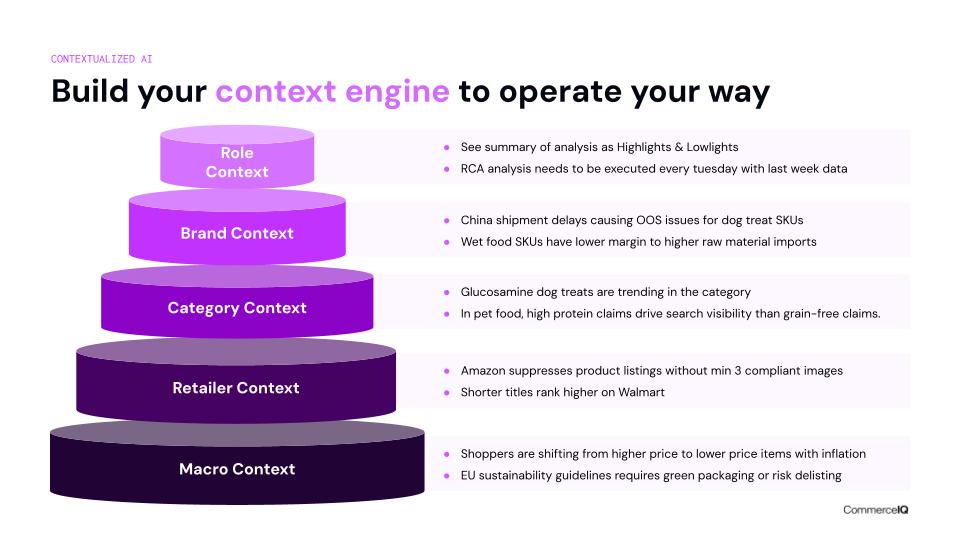
Agents pull context from multiple layers. At the macro layer, they track economic shifts, pricing trends, and buying behavior. At the marketplace layer, they monitor specific requirements, such as Amazon suppressing listings that have fewer than three images. At the category layer, they surface trending products, top-searched claims, and competitor moves.
The hardest part isn't tracking these signals — it's determining correlation and causality between them and outcomes, then applying that learning to a brand's topline goals (sales, share, profit) and the way the team operates. This is what an experienced category manager does in their head all day. Teaching an agent to do it for a specific brand takes months of observation and feedback, since they can only cover a portion of the brand's catalog at a time.
This is why, before agents can start acting autonomously, they need human oversight and input to review early recommendations, correct misreads, and refine the guardrails within which they operate. That back-and-forth improves the agent until the team trusts it to execute on its own.
The brands that put in that work months ahead of Prime Day walk in with something their competitors can't replicate on short notice: months of compounding context behind every decision their agents make.
Agents learn from every action and the feedback they receive, informing their next recommendation and the one after that. A brand with well-trained agents enters Prime Day with months of compounding intelligence behind every decision. That intelligence only matters when it's applied at the speed at which marketplace algorithms change.
Brands typically outsource thousands of monthly optimizations across their retail media campaigns and product listings to agencies. Even with rules-based automation, a traditional media agency runs roughly 100 optimizations per day, where an agent runs 4,000-plus. But those 4,000 optimizations are only as good as the context behind them. Brands that put that foundation in place and invest in providing that insight months in advance of big sales events like Prime Day will have a fundamentally different outcome than those that don't.
While a competitor is rushing to manually update their top SKUs the week before Prime Day, a brand leveraging trained agents is already optimizing across a full catalog. Its content agent adjusts PDPs based on what shoppers are actively searching for, while its media agent reallocates spend to the campaigns delivering the strongest returns.
All of this runs 24/7 and is informed by months of data. So while a brand that adopts agentic retail late can match the volume of optimizations, it won't have the context behind them. Meanwhile, the brands that started early will have both, and that difference will show come Prime Day.
Last year's Prime Day proved that spending more doesn't guarantee earning more. Agentic retail gives CPG brands a way to operate at the necessary speed on Prime Day, but that advantage doesn't reach its full potential when brands flip the "on" switch the week before. The brands that start now will spend Prime Day executing across their full catalog with agents that already have the context to make an impact.